
Tuesday 24 November 2026
The ACT has retained its position as Australia’s most affordable rental market but rents remain unaffordable for many low- and middle-income earners, according to the 12th annual National Shelter-SGS Economics and Planning Rental Affordability Index.
The study, which compares median rents to average incomes, found the ACT’s rental affordability held steady over the past year, with Canberra remaining one of two capital cities in the country classed as Acceptable, where the average renting household spends 23% of its income on rent.
However, experts say headline stability is masking a punishing two-tier rental system. Canberra’s leading score is driven mainly by the city’s comparatively high average incomes, while low-income earners and key workers face a different reality.
While Canberra’s average rental household earns $142,658, when viewed through a distributional lens the figures obscure the entrenched crisis faced by those on lower incomes.
Early childhood educators face severe rental stress, spending 37% of their income on rent, while full-time hospitality workers spend 38%. The index found people receiving JobSeeker and pensioners face Critically Unaffordable to Severely Unaffordable rents.
ACT Shelter CEO Corinne Dobson said: “Numbers that show Canberra as Australia’s most affordable capital only tell half the story and the reality is completely different, with the high average incomes masking the brutal reality for low-income earners.
“While those on average or above-average incomes may be able to manage the cost of renting, for our key workers or those living on income support or the age pension, rents in our country’s capital city are still crushingly high.
“Tenancy reforms like the cap on rent increases have provided critical protections for renters but a sustained and long-term pipeline of dedicated public, community and affordable housing is necessary to make sure lower-income Canberra residents aren’t priced out of a home.”
SGS Economics & Planning Principal Ellen Witte said: “Rental affordability has been improving in Canberra over recent years and this trend is supported by increased housing supply and overall high incomes. This jurisdiction is bucking the national trend. The ACT put limits on the extent and frequency of rent increases, and this suggests that straightforward, targeted affordability measures can have a real positive impact.
“With some of the country’s highest income levels and targeted policy, Canberra has managed to avoid steep declines seen in other areas like Hobart and Perth. But we also know there is extreme vulnerability among lower income households.
“Pensioners, part-time working single parents and hospitality workers all face an extremely unaffordable market paying 44% to 99% of income on rent. Pockets like Curtin, Garran, Monash and Macarthur are becoming unaffordable for even moderate-income households.
“Tenants are between a rock and a hard place. Lower income households have to make hard decisions: parents are skipping meals, young adults remain living with their parents for longer, couples may delay having children and more people live together in one house, leading to overcrowding and stress.“
Robert Pradolin, Founder & Executive Director of Housing All Australians said: “Canberra’s rental crisis is failing the people who keep the city functioning.
“Early childhood educators, aged-care workers, cleaners, hospitality workers and other essential employees are increasingly being priced out of the communities where their services are needed.
“Housing that people on middle and lower incomes can afford is fundamental economic infrastructure. Without it, productivity is held back, employers struggle to find staff and essential community services come under increasing pressure.
“Neither the ACT Government nor the Australian Government can bridge Canberra’s housing gap alone. Housing All Australians wants to work constructively with both governments, alongside business, institutional investors and the community sector, to develop practical solutions that unlock private-sector capital, land, capability and innovation and substantially increase social and affordable housing supply. Canberra’s employers depend on these workers and have a direct interest in becoming part of the solution.”
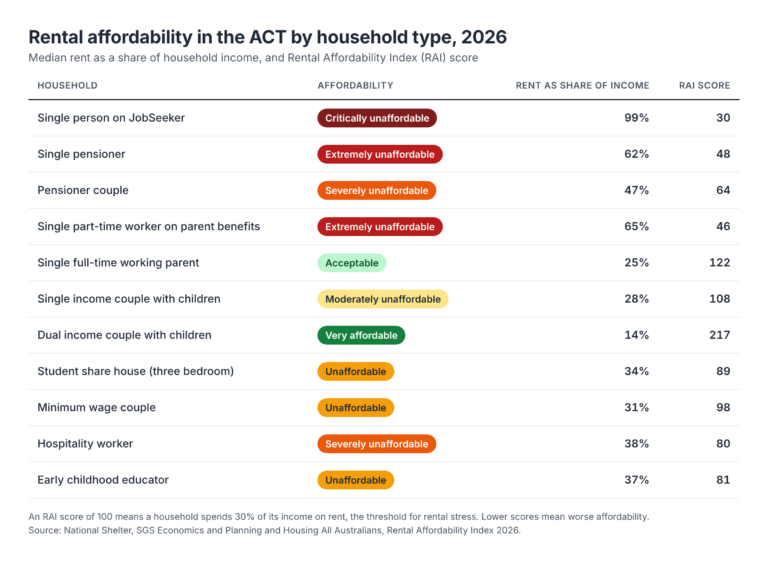
EDITOR’S NOTE: The Rental Affordability Index scores are based on median rental prices and the average income of renting households within a capital city or rest-of-state area. A score of 100 represents the point where the average household spends 30% of its income on rent, the critical threshold for housing stress. Lower scores indicate worse affordability.
RAI dashboard can be accessed here.
Media contact: Lauren Ferri 0422 581 506